
Post-Amputation Home Adaptation in Kimberly, WI
Safe, independent living at home in Kimberly with custom post-amputation home adaptation, ramps & grab bars. Call us at (920) 585-8780.

Post-amputation home adaptation starts with a hard truth: after limb loss, your house suddenly has new rules. A narrow bungalow doorway, a raised threshold or a steep basement stair can stop a walker, wheelchair or prosthesis cold. Dodd Home Safety comes to your Kimberly home and measures your mobility aid in person. Then we fit grab bars, ramps, hinges and lifts to your actual house. Give us a call at (920) 585-8780 and we’ll talk through what your home needs.
How Kimberly’s Older Homes Meet Life After Limb Loss
Many Kimberly homes are 1950s mill-worker bungalows, ranches and older two-stories. They were built for a different kind of living. Doors run narrow, stairs run steep, and entries sit high off the ground.
Then winter arrives. Kimberly averages about 49 inches of snow a year, and January lows sit near 10°F to 13°F. Icy wind off the Fox River glazes steps fast, so a wheelchair ramp built for Wisconsin winters often beats a set of slick concrete steps.
- Many interior doorframes measure 28 inches, which is tight for some walkers and wheelchairs.
- Steep basement stairs leave little room for a safe handrail or a missed step.
- Raised entry thresholds catch crutch tips and prosthetic feet.
- Icy front steps need slip-resistant surfaces and sturdy handrails every January.
- Old plaster walls hide their framing, so a grab bar needs wall blocking, which is extra wood set inside the wall to hold its weight.
Post-amputation changes are one part of a bigger set of mobility gear. If you’re weighing options, look through what we install as a Kimberly disability equipment supplier. Seeing the full range of ramps, rails and lifts before a home visit makes the visit easier.
Room-by-Room Changes That Help After Limb Loss
Catalog packages rarely fit a real house, and every amputation is different. That’s why we don’t hand them out. Each change is chosen for your home after we see how you move through it.
- Bathrooms: toilet safety modifications, a shower seat, non-slip flooring, and grab bars anchored into solid wall blocking.
- Entrances and garage landings: modular aluminum or custom wood ramps, threshold ramps and sturdy handrails.
- Hallways and doorways: we measure your walker or wheelchair in person. Offset hinges gain about two inches of clear swing, and we widen the opening if that falls short.
- Stairs: a straight or curved indoor stair lift, an exterior stair lift, and continuous handrails.
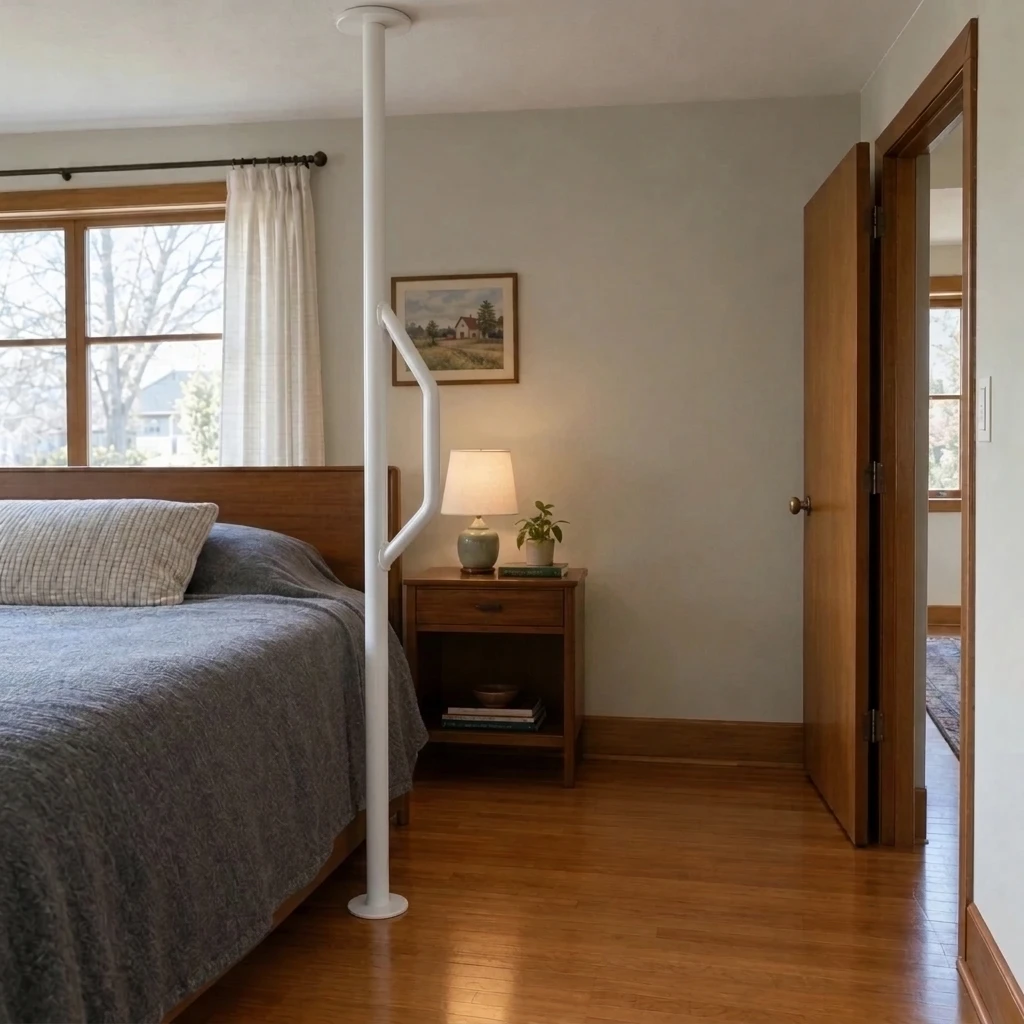
- Bedrooms and kitchens: transfer poles, brighter senior-friendly lighting, non-slip flooring and clear pathways.
Our in-home mobility and safety assessments are where each of these decisions starts. Kimberly homes vary a lot from street to street. What works in one hallway may not fit the next.
What to Expect When You Work With Us
Rehab after limb loss often centers on balance, strength and learning to use a prosthesis, which is an artificial limb[1]. Our visit looks at how those skills meet your actual rooms.
- We start with a phone conversation about your recovery, your mobility aid and your daily routine.
- Bill and Jaci visit your home, watch how you transfer between bed, chair and toilet, and measure turning space to the quarter inch.
- We explain each change and why we picked it before a single screw is turned.
- Bill and our installation crew do the work, setting wall blocking exactly where the evaluation points.
- We can point you toward the Outagamie County Aging and Disability Resource Center, Wisconsin Family Care, IRIS and the Outagamie County Veterans Service Office, and the VA offers Specially Adapted Housing and Special Home Adaptation grants to eligible veterans[2].
Bigger projects, like a new entry or a widened doorway, fall under our home modification work in Kimberly. You get one plan for the whole house instead of piecemeal fixes.
Why Choose Dodd Home Safety
Safety gear that looks medical can make your own home feel like a clinic. Bill Dodd and Jaci Dodd run Dodd Home Safety as partners, and we pick rails and ramps that blend into your house.
- Bill is a licensed Occupational Therapy Assistant and a Wisconsin Dwelling Contractor Qualifier.
- Bill brings 13 years of experience to home safety evaluations and the installation work.
- Jaci is a Physical Therapist Assistant, and she handles mobility, transfer and home safety evaluations.
- We base every update on an in-home evaluation of your house, with no guessing and no generic catalog solutions.
- We drive to you across Kimberly, Appleton, Kaukauna, Little Chute and Combined Locks.
Frequently Asked Questions
What does home adaptation after an amputation involve?
It means fitting your house to the way you move now. We watch how you transfer, measure your walker, crutches or wheelchair, and then add ramps, rails, hinges or lifts where they matter most. We decide what to install only after an in-home evaluation of your home.
Will my wheelchair or walker fit through a narrow bungalow doorway in Kimberly?
Many Kimberly bungalows have 28-inch doorframes, so it depends on your home and your aid. We measure your walker or wheelchair in person. Offset hinges gain about two inches of clear swing, and if that isn’t enough, we widen the opening to fit.
How do I get safely up icy front steps in a Kimberly winter?
Slip-resistant ramps, sturdy handrails and level thresholds make the biggest difference. We design a ramp around your entry’s rise and run. It’s built to hold up through Wisconsin winters.
How do you make a bathroom safe after a lower-limb amputation?
We focus on safety hardware and equipment. That can include grab bars anchored into solid wall blocking, which is extra wood set inside the wall to hold weight, plus a shower seat, a raised or modified toilet, and non-slip flooring. We watch how you move before we pick where each piece goes.
Do I need to widen doorways or install a ramp after an amputation?
Not always. A raised threshold may only need a threshold ramp, and a narrow doorway may only need offset hinges. The on-site evaluation shows whether a wider opening or a full ramp fits your home and your mobility aid.
Is there help paying for home changes in Outagamie County?
Options exist. The Outagamie County Aging and Disability Resource Center, Wisconsin Family Care and the IRIS waiver program are good places to ask. Veterans can ask the Outagamie County Veterans Service Office about VA grants for home adaptations.
What home modifications are needed after an amputation?
It depends on your amputation, your mobility aid and your house. Common changes include ramps, grab bars, handrails, doorway fixes, stair lifts, transfer poles and better lighting. We pick each one after seeing how you move through your rooms.
Ready to Get Started?
Dodd Home Safety — serving Kimberly, WI. Call us today.
References & Local Research
- [1] American Physical Therapy Association. (2023). Physical therapy guide to health. APTA Choose PT. https://www.choosept.com/why-physical-therapy
- [2] U.S. Department of Veterans Affairs. (2022). Specially adapted housing and special home adaptation grants. VA Benefits Administration. https://www.va.gov/housing-assistance/disability-housing-grants/