
Parkinson’s Disease Home Modifications in Kimberly, WI
Prevent falls and stay independent in Kimberly with tailored Parkinson’s Disease Home Modifications built around your home. Call (920) 585-8780 Families exploring funding options can also learn how Medicaid Waiver Home Modifications in Kimberly, WI work through medicaid waiver home modifications that may help cover eligible safety upgrades. For added support when standing up from bed or steadying yourself during transfers, Transfer Pole Installation in Kimberly, WI provides a sturdy floor-to-ceiling grab point, and a professional transfer pole installation ensures it is secured properly for daily use. Because tremors and reduced grip strength can make round knobs difficult to turn, Lever Door Handle Installation in Kimberly, WI, including a properly fitted lever door handle installation, makes moving from room to room easier and safer.
Parkinson’s can turn a familiar house into an obstacle course. Feet freeze at a doorway, hands shake on a stair rail, and a short walk takes real effort. Dodd Home Safety measures your home in person. Then we install the rails, ramps, lighting and layout changes that fit how you actually move. Give us a call at (920) 585-8780 and we’ll set up a visit to your home in Kimberly.
A Kimberly Winter Is Hard on Unsteady Feet
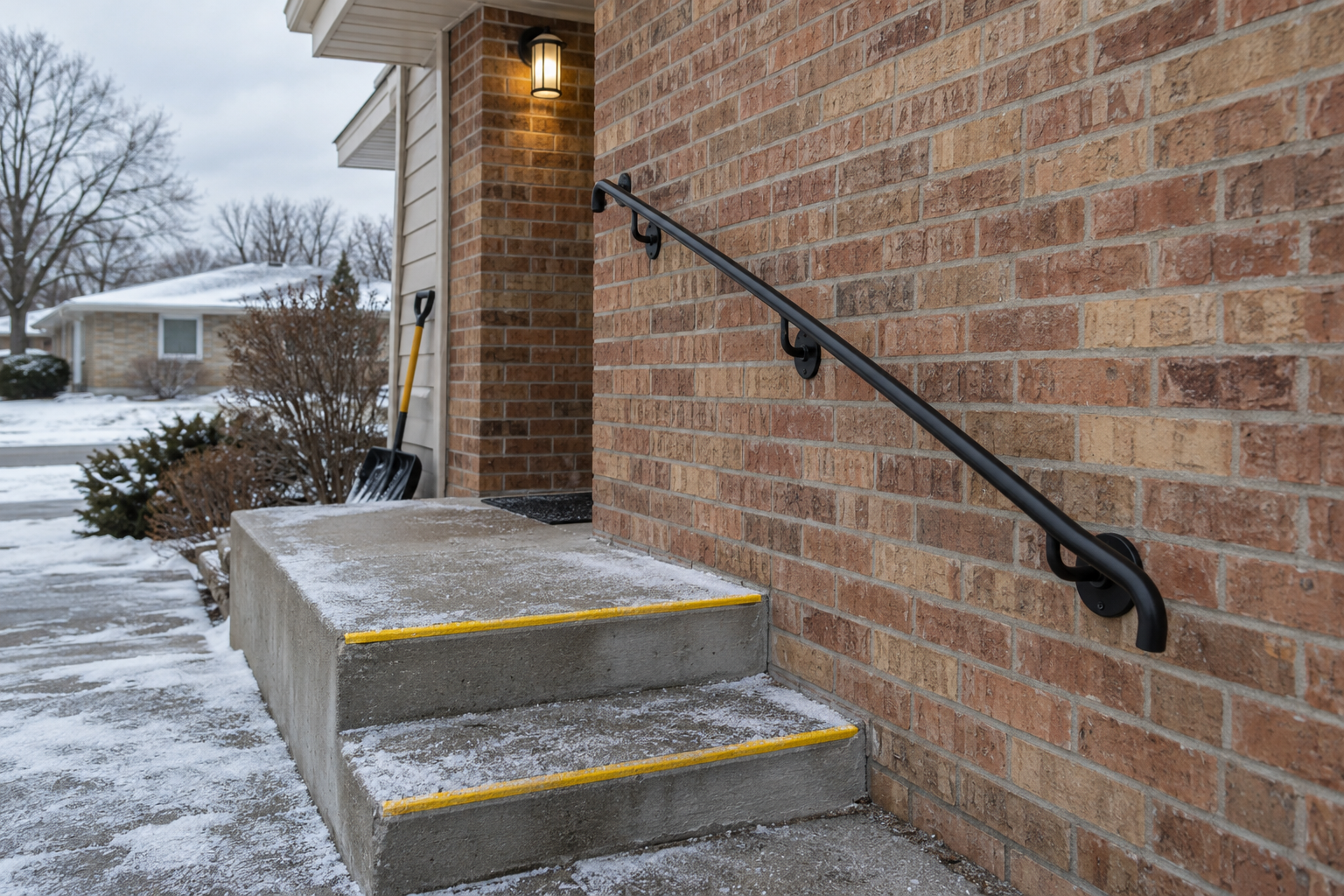
Many homes here are 1950s bungalows with steep basement stairs, raised thresholds and narrow doors. Every few winters, a thaw followed by a hard freeze glazes the steps overnight. Blowing snow off the Fox River floodplain covers the rest. For someone with Parkinson’s, a skim of ice is more than a nuisance.
Parkinson’s can bring freezing of gait, which means the feet feel stuck to the floor. It can also bring tremor, which is shaking, and bradykinesia, which is slow movement. Most adults say they want to stay in their own homes as they age[1]. The right changes make that possible.
- Frost-ready modular aluminum ramp options sized to your entry’s exact rise and run.
- Non-slip surfaces on outdoor steps and landings, so boots and walkers grip.
- Well-lit garage entry landings, with lights that switch on before you reach the door.
- Handrails on the wall side that run past the top and bottom steps.
- Permit planning: permanent ramps need a Village of Kimberly building permit under Wisconsin SPS 321.045, and review can take up to 10 business days.
Parkinson’s is rarely the only change a household is working through. Our disability equipment for Kimberly homes shows what else can fit. Ramps, lifts and bars all start with the same in-home measuring.
Room by Room: Where the Changes Go
Every house is different. These are the places we look at first.
- Bathroom: extra wood blocking behind the wall so grab bar placement holds firm, plus raised toilets, transfer poles and threshold fixes.
- Stairways and hallways: continuous handrails and lighting that shows every tread. For a 28-inch doorway, we measure your walker or wheelchair in person, then fit offset hinges for about two more inches of clear swing or widen the opening.
- Bedroom: a bed edge at the right height, a bedside rail and a lit, clear path to the bathroom.
- Kitchen and living areas: lever handles, a firm chair with arms, and floors with no loose rugs or cords.
- Entrances and garage landings: a level landing, sturdy rails and good light, so the first step in the door isn’t the hardest.
Parkinson’s changes over time, so the first step is watching how you move. Our home and mobility evaluations in Kimberly look at transfers, turning space and balance before anything gets built. Start there if you’re unsure what your home needs.
What to Expect From First Visit to Finished Work
It’s an evaluation first and a construction project second. No guessing, and no generic catalog picks.
- We watch first. We see you walk, turn, sit and stand in your own rooms.
- We measure. Doorways, stairs, landings and turning space get measured to the quarter inch.
- We plan on paper. Each piece is chosen for your house, not for a sales pitch.
- We build. Bill and our installation crew set wall blocking first, then mount the hardware.
- We walk it with you. We check heights and reach together, and adjust anything that feels off.

Why Choose Dodd Home Safety
Parkinson’s work takes a careful eye and a builder’s hands. Bill Dodd and Jaci Dodd run Dodd Home Safety as partners. Here’s who does what.
- Bill is a licensed Occupational Therapy Assistant and a Wisconsin Dwelling Contractor Qualifier.
- Bill does home safety evaluations and handles the contracting and installation work with our installation crew.
- Jaci is a Physical Therapist Assistant. She does mobility, transfer and home safety evaluations.
- We look at how you move, then fix what we find in the walls, floors and entries, all in one visit plan.
- Safety doesn’t have to look medical. Rails and bars are chosen to blend into your home.
Many of these pieces are small and quiet. Our safety equipment for Kimberly homes page shows rails, bars and poles that look like part of the house.
Frequently Asked Questions
Where should we start after a new Parkinson’s diagnosis?
Start with the places you move most: the bathroom, the bedroom and the main entry. An in-home evaluation looks at how you walk, turn and transfer, which means moving from bed to chair or chair to toilet. The riskiest spots get fixed first, with room to adjust as Parkinson’s changes.
What home modifications help people with Parkinson’s disease?
Common changes include grab bars with wall blocking behind them, continuous handrails, raised toilets, transfer poles and better lighting. Ramps, level thresholds and lever door handles help at entrances and doorways. Which ones fit depends on how you move and how your house is laid out.
How do you make a home safe for someone with Parkinson’s disease?
Begin with the places where freezing of gait, which means the feet feel stuck, is most likely. Doorways, stairs and entry landings are the usual spots. Clear floors, bright step edges, sturdy rails and good light cut the risk of a fall.
Do I need a building permit to install a wheelchair ramp in Kimberly, WI?
Permanent ramps need a building permit from the Village of Kimberly. They are built to Wisconsin SPS 321.045. Zoning and inspection review can take up to 10 business days.
Does Medicaid Family Care or IRIS pay for home modifications in Wisconsin?
They may help. The Outagamie County Aging and Disability Resource Center, Wisconsin Family Care and IRIS waiver programs are good places to ask about coverage. Eligibility depends on your situation, so the program decides what it will pay for.
Can veterans get help paying for Parkinson’s home changes in the Fox Cities?
Veterans may qualify for VA adaptation grants. The Outagamie County Veterans Service Office can explain the options and how to apply. Local VA funding programs may also help with adaptive safety equipment.
Will my house end up looking like a hospital?
No. Safety doesn’t have to look medical. Finishes and fixtures are chosen to suit your home, and each piece is picked after an in-home evaluation.
Ready to Get Started?
Dodd Home Safety — serving Kimberly, WI. Call us today.
References & Local Research
- [1] AARP Public Policy Institute. (2021). Home and community preferences survey: A national survey of adults ages 18-plus. AARP Research. https://www.aarp.org/research/topics/community/info-2021/home-community-preferences.html